
Baltimore, or “Bawlamer,” as locals call it in their rolling accent, is one of America’s oldest cities. In 1850, it was the second largest city in the US. By 1950, it had reached its pinnacle, near one million strong. Ever since, it has seen a steady decline in population, but it hasn’t lost its many charms. Over the decades, Baltimore has kept its streets of brick “rowhouses,” its old city buildings, and its large, influential port.
However, recently, the city has experienced a cultural revitalization. The city’s economy is growing again, and its downtown is burgeoning, led by two classy sports arenas, Camden Yards and M&T Bank Stadium, and many surrounding restaurants and galleries.
Baltimore’s Layout
Baltimore is located on the Atlantic Coast. It’s built next to the Patapsco River, which empties into the nearby Chesapeake Bay and the Atlantic Ocean. Due to its location, Baltimore is the largest port in the mid-Atlantic region of the US.
The city has a sharp elevation change. One half (lower Baltimore) is at sea level. More inland, the city (upper Baltimore) climbs onto the Piedmont Plateau, about 450 feet above sea level. The surrounding area is comprised of relatively flat wetlands and forest.
Baltimore is the largest city in a metropolitan area that includes the nearby city of Towson. It is home to 2.7 million people. Washington DC is not far away, just about an hour’s drive. The entire region is home to over 8 million people.
Positives of Moving to Baltimore
Transportation – Baltimore has a solid public transit system, with a bus system, a light rail system and a subway system. Though its rail systems are not as comprehensive as, say, Washington DC’s, they are still extremely useful for residents. The city is also ranked as the 14th most walkable large city in the US, and has an oft-used Amtrak station.
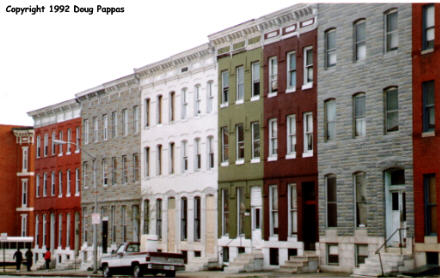
Architecture – Back in history, Baltimore residents decided to build their homes like those built in England – flat, brick buildings situated immediately next to each other. Today, most of these brick “rowhouses” remain, and they give Baltimore a very unique, classic feel. The city also has a number of refined government buildings, most notably Baltimore City Hall, and commercial buildings hailing from the early 1800’s.
Location – Baltimore’s location (essentially) on the Atlantic has brought it trade and jobs for hundreds of years. Additionally, its proximity to nearby major cities, including Philadelphia and Washington DC, make it a prime location for businesses and travel-hungry residents.
Sports Scene – Baltimore is home to the Ravens (NFL) and Orioles (MLB). While this might seem irrelevant to many, it is not. The teams have spearheaded a downtown revitalization. Both have built state-of-the-art, critically-acclaimed arenas in what used to be a decrepit warehouse district. Restaurants, bars, arts and people have followed. The area is now among the most lively in the city and one of the best sports centers in the nation.
Negatives of Moving to Baltimore
Economy – Baltimore has always had a “blue-collar” economy, meaning it has depended heavily on manual labor, namely at its ports. In recent years, manual labor has tapered off, replaced by the manual labor of the Internet age: call centers. Baltimore has jobs, but most of them pay little compared to other industries. Also, the city suffers from unemployment near 11%, and many of its residents live below the poverty line.
Crime & Bad Neighborhoods – Baltimore isn’t abnormally dangerous or derelict. However, it does experience higher crime than many cities, namely in a few of its more dangerous neighborhoods, like its Eastern District. Also, some of its neighborhoods have been all but abandoned.
Weather – Baltimore gets better weather than other northern cities, because the Atlantic Ocean keeps it temperate. However, it is still subject to below-freezing temperatures during the winter months; it can get uncomfortably hot and humid in the summer; and it gets a lot of rain in between.
Thinking about moving to Baltimore? Check out some Baltimore moving companies. Find them for free here: Baltimore movers.